Admissions Open — 2026 Batch

B.CCT | Allied Healthcare Sciences

Bachelor of
Critical Care Technology.

Cultivating Expert Critical Care Specialists. A comprehensive 4-year programme designed to develop skilled healthcare professionals for intensive care settings.

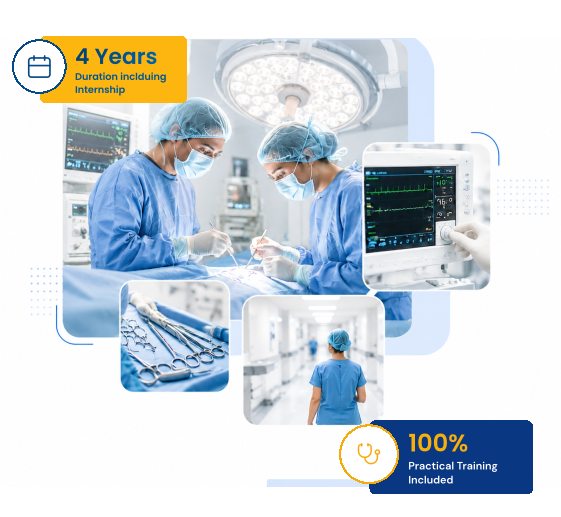
4-Year Programme 10+2 with Science Clinical Hospital Exposure Internship Included Industry-Oriented Curriculum
4 Years Programme Duration
Clinical Exposure
Advanced Ventilator & Critical Care Exposure
Multiple Career Tracks Available

The Bachelor of Critical Care Technology (B.CCT) at Apollo Healthcare Academy is a 4-year undergraduate programme specifically designed to equip students with the clinical skills and technological expertise required in modern intensive care units. The curriculum consists of a rigorous academic foundation and ample clinical experience, which gives learners the ability to operate in ICUs, CCUs and emergency departments.

The syllabus is comprised of everything, including ventilator system management and monitoring of advanced cardio-respiratory parameters on a constant basis. The complete programme has been crafted in accordance with the national and international healthcare standards.

Being focused on clinical accuracy and academic rigour, the programme carefully prepares the students to work in patient monitoring, advanced life support systems, emergency methods and procedures used to operate critical care equipment. After successfully completing the course, students will graduate as competent allied health professionals to work with multi-disciplinary teams in the healthcare environment.

program-images-top-right

WHY B.CCT

Programme Highlights

The Bachelor of Critical Care Technology (B.CCT) programme at Apollo Healthcare Academy combines academic depth with real-world exposure to critical care. The programme prepares students for work in high-acuity clinical settings through structured clinical training and technology-based curriculum. The course is aimed at developing competence in intensive care practice, patient monitoring and emergency response.

01
Cutting-edge Curriculum

Advanced Simulation

Hands-on training with high-fidelity simulators replicating critical care scenarios and emergency procedures.

02
Hospital Rotations

Supervised Practice

1000+ hours of clinical rotations in ICUs and CCUs across specialized departments in Apollo Hospitals.

03
Hands-on Training

Academic Rigour

Curriculum aligned with international healthcare standards, focusing on clinical accuracy and technological expertise.

04
advance lab

Certification Ready

Preparation for globally recognized certifications including BLS, ACLS, and PALS during the programme.

dot grid
Programme Objective
ABOUT THE PROGRAMME

Programme Objective

To build a solid foundation in the principles and practices of critical care, emergency medicine and intensive care technology.
To equip students with abilities to demonstrate technical and clinical competencies in patient monitoring, ventilator management and life-support systems.
To provide hands-on training in real-time ICU, CCU and emergency settings, enabling accurate response to critical scenarios.
To foster analytical thinking, ethical conduct and interdisciplinary communication essential for effective critical care delivery.
To train students in managing specialised critical care areas and evaluating performance using advanced intensive care technologies.
dot-images
CORE CURRICULUM

COURSE STRUCTURE

The four-year programme progressively builds the clinical, technical and ethical skills needed to work in an intensive care environment. The course incorporates fundamental sciences, advanced concepts of critical care and clinical practice to prepare students for the high acuity health services.

image-not-found

Year 1

Foundational Learning

badge 20% Hands-On Experience in Real Hospital

Anatomy & Physiology Basic Biochemistry Microbiology & Pathology Introduction to Critical Care Medical Ethics Basic Life Support Clinical Psychology Hospital Information Systems Communication Skills Fundamentals of Nursing Basic Medical Procedures
01
image-not-found

Year 2

Clinical Exposure

badge 40% Hands-On Experience in Real Hospital

Advanced Cardio-Respiratory Care Intensive Care Equipment & Technology Emergency Medicine Critical Care Pharmacology Ventilator Management & Technology Clinical Assessment in Critical Care Trauma Management Patient Monitoring Systems Infection Control & Prevention
02
image-not-found

Year 3

Advanced Specialisation

badge 60% Hands-On Experience in Real Hospital

Specialised Critical Care (Cardiac, Neurological, Paediatric, Burn) Advanced Life Support Systems Critical Care Research Methodology ICU Management & Quality Improvement Nutritional Support in Critical Care Renal Replacement Therapy Advanced Ventilation Techniques Critical Care Documentation
03
image-not-found

Year 4

Internship & Hospital Residency

badge 100% Hands-On Experience in Real Hospital
Job Training & Clinical Internship
04
ADMISSION INFORMATION

Programme Admission, Fees & Scholarships

Everything you need to know about eligibility, admission pathways, programme fees, and scholarship opportunities for the Bachelor of Critical Care Technology (B.CCT). programme.

icon

ELIGIBILITY CRITERIA

  • tick Applicants must have completed 10+2 or equivalent with Physics, Chemistry and Biology as required subjects and a minimum of 50% aggregate marks from a recognised board.
  • tick Students with a PCM background who take Biology as a supplementary course are also eligible.
  • tick Must have passed class 12th with at least 45% (40% for reserved category students) marks with Biology, Physics and Chemistry and attain 17 Years as on 31st December of the calendar year.
icon

TUITION FEE

₹2.5 LAKH

PER ANNUM

The tuition fee for the Bachelor of Critical Care Technology (B.CCT) programme is 2.5 lakh per annum.

icon

SCHOLARSHIP (BASED ON COMPOSITE SCORE)

badge
COMPOSITE SCORE

95 and above

25%

Tuition Fee Waiver

badge
COMPOSITE SCORE

90 - 94.99

15%

Tuition Fee Waiver

badge
COMPOSITE SCORE

85 - 89.99

10%

Tuition Fee Waiver

images
  • tick Scholarships will be allocated in descending order of Composite Score until the scholarship allocation (10% of intake) is filled.
  • tick Meeting the score criteria does not guarantee award of scholarship if the allocated scholarship capacity has been reached.
Doctor
CAREER OUTLOOK

Build a Rewarding Career in OT Technology

Graduates may explore international careers through higher education pathways, certification-based migration routes, and global healthcare recruitment programmes.

global opportunities

growing DEMAND FOR ot pROFESSIONALS

Additional licensing, certification, or country-specific eligibility requirements may apply.

  • Expansion of ICUs, CCUs, and high-dependency units across healthcare systems.
  • Rising prevalence of critical illnesses requiring intensive monitoring and advanced life support.
  • Increasing adoption of advanced ventilator and patient monitoring technologies.
  • Growth in trauma, emergency, and post-operative critical care services.
  • Greater focus on multidisciplinary intensive care management.
  • Increasing demand for trained allied healthcare professionals in critical care environments.

Continue your education

icon-image Master’s in Critical Care Technology
icon-image Advanced Intensive Care & Emergency Care Programmes
icon-image MBA in Healthcare Management
icon-image Clinical Research Programmes
icon-image Hospital Administration Courses
icon-image Advanced Life Support Certifications
icon-image Pulmonary & Cardio-Respiratory Care Specializations
icon-image Healthcare Quality & Patient Safety Programmes
CAREER OPPORTUNITIES

Your Career after B.CCT

Graduates of the Bachelor of Critical Care Technology (B.CCT) programme are ready to work in high-acuity settings, providing clinical care in hospitals and critical care environments. They are confident and effective at performing in clinical settings, supporting medical technology usage with the knowledge of specialised ICU/critical care protocols and using advanced life support systems.

CAREER TRACK PRIMARY WORK ENVIRONMENT KEY RESPONSIBILITIES
Critical Care Technologist Intensive Care Units (ICUs) Patient monitoring, ventilator management, critical care support
Cardio-Respiratory Technologist Cardiac & Pulmonary Care Units Monitoring cardio-respiratory parameters and advanced support systems
Emergency Critical Care Associate Emergency & Trauma Centres Supporting emergency interventions and acute care procedures
ICU Care Coordinator Multi-speciality Hospitals Coordinating ICU workflow, patient care support, and equipment management
Ventilator Support Specialist Critical Care Units Managing ventilator systems and respiratory support technologies
Trauma & Life Support Associate Trauma Centres & Emergency Units Assisting trauma response and advanced life-support procedures
Critical Care Services Executive Healthcare Institutions Supporting multidisciplinary critical care operations and patient management
1
ENTRY LEVEL

Junior Critical Care
Technologist

0–2 Years

2
MID LEVEL

Senior ICU
Technologist

3–5 Years

3
ADVANCED

Critical Care Specialist
/ ICU Supervisor

5–8 Years

4
LEADERSHIP

Critical Care Services Manager
/ ICU Operations Coordinator

8+ Years

FAQ

Frequently Asked Questions

Everything you need to know about eligibility, admission pathways, programme fees, and scholarship opportunities for the Physician Associates (B.PA) programme.

Contact Us

Disclaimer:

Programme structure, curriculum, and clinical exposure components may be updated periodically in line with academic and industry requirements. Internship opportunities are subject to institutional and healthcare partner availability. Career progression depends on individual performance, experience, certifications, and market conditions. International opportunities may require additional examinations, licensing, or country-specific certifications. Placement support does not guarantee employment. Images and testimonials are for illustrative and informational purposes.

Enquire Now
Enquiry Form