

Healthcare is often associated with doctors, surgeons, and nurses. But behind every successful
diagnosis, surgery, rehabilitation plan, or emergency intervention stands a highly skilled workforce that
quietly powers the healthcare system — Allied Health Professionals (AHPs).
From laboratory technologists and physiotherapists to respiratory therapists and radiology experts,
allied health professionals form the backbone of modern healthcare delivery. As India’s healthcare
sector rapidly expands, the demand for these professionals is creating one of the most significant
career opportunities of the decade.
The Invisible Workforce Driving Healthcare
Modern medicine functions as a coordinated ecosystem. While physicians lead diagnosis and treatment
planning, allied health professionals ensure that patient care is effectively delivered.
Consider a few examples:
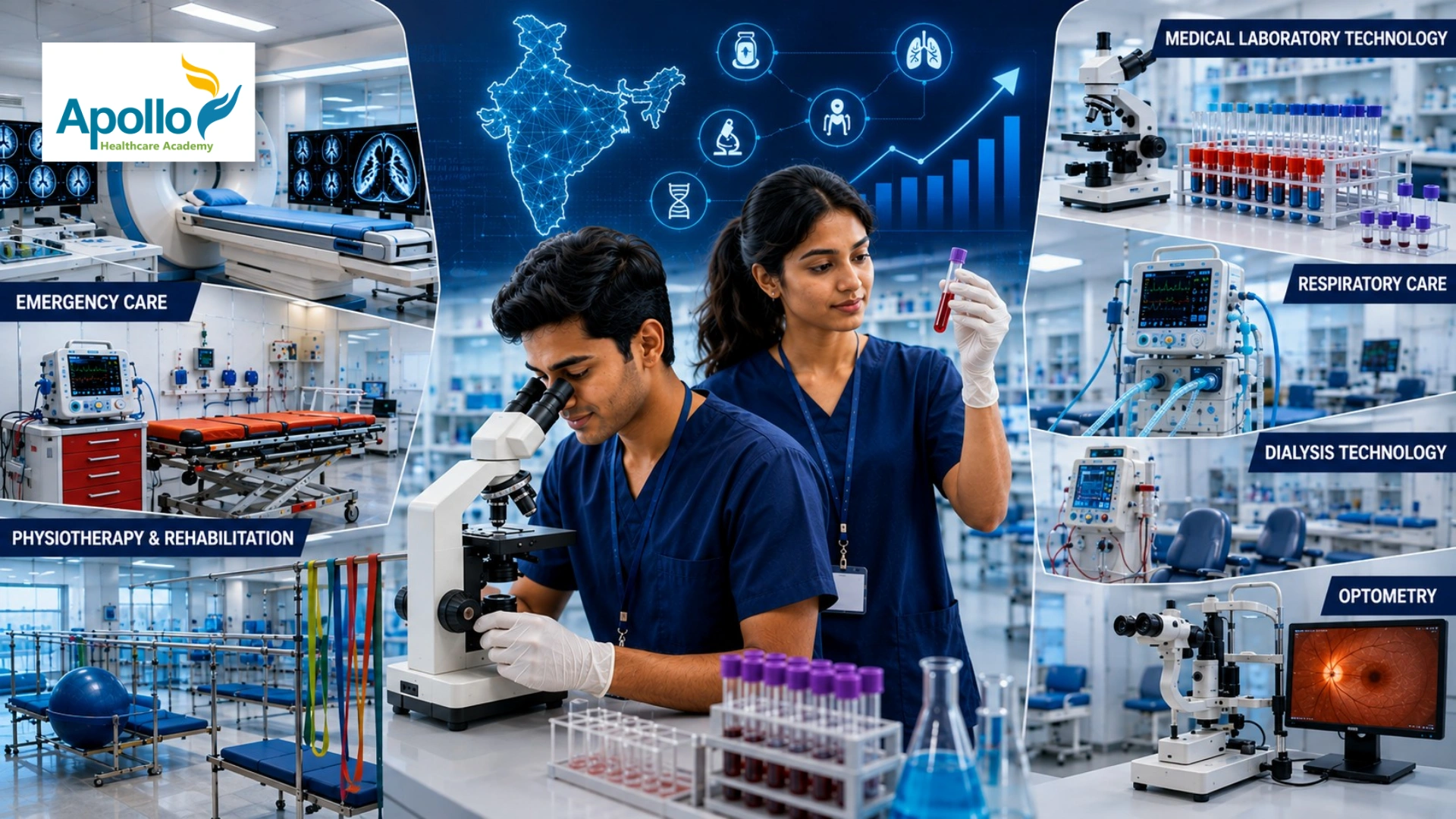
- Alaboratory technologist processes diagnostic samples accurately.
- A physiotherapist helps a patient regain mobility after surgery.
- A respiratory therapist manages life-saving ventilator support in intensive care units.
- A radiology technologist enables precise imaging for diagnosis and treatment planning.
- A speech-language pathologist supports stroke survivors and children with developmental
disorders.
Without allied health professionals, healthcare systems simply cannot function efficiently.
Globally, advanced healthcare systems maintain strong support structures for physicians. In countries
such as the United States and Australia, one doctor is typically supported by four to six allied health
professionals. In India, however, this ratio remains close to 1:1 — highlighting a massive workforce gap
and an urgent national need.
India’s Massive Allied Health Workforce Gap
India currently has approximately 7 allied health professionals per 10,000 people, compared to nearly
80 in Australia and over 150 in the United States. This translates into an estimated shortage of more
than 6.5 million allied health professionals nationwide.
At the same time, the global healthcare sector is facing an unprecedented workforce crisis. According to
WHO estimates, the world may face a shortage of over 11 million healthcare workers by 2030.
Countries across the globe are actively recruiting skilled healthcare talent:
- The United States is expected to add nearly 2 million healthcare jobs by 2034.
- Japan faces a shortage of more than 570,000 care workers.
- The UK’s NHS plans to recruit tens of thousands of additional allied health professionals over the
coming decade.
For Indian students, this creates a powerful opportunity: careers that are stable, future-proof, globally
relevant, and deeply meaningful.
Emerging Careers That Will Define the Future of Healthcare
The future of healthcare is evolving rapidly, creating demand for entirely new categories of allied health
professionals.
Genetic Counsellors
As precision medicine and genomic testing become mainstream, genetic counsellors will play a crucial
role in helping patients understand inherited diseases and treatment pathways.
Respiratory Therapists
The COVID-19 pandemic exposed the critical shortage of respiratory care specialists in India. With
millions affected by respiratory illnesses such as COPD and asthma, demand for respiratory therapists is
expected to grow significantly.
Speech-Language Pathologists
ndia has a severe shortage of speech and language specialists despite rising cases of autism spectrum
disorders, stroke rehabilitation needs, and geriatric care requirements.
Clinical Informatics & AI Healthcare Specialists
Healthcare is becoming increasingly digital. Professionals who can bridge medicine, technology, AI, and
healthcare data systems will become indispensable in modern hospitals.
Geriatric Care Specialists
India’s ageing population is expected to cross 300 million by 2050. This demographic shift will create
enormous demand for specialised elderly care services.
Mental Health Counsellors
Mental health awareness is increasing rapidly, but access to qualified professionals remains limited. The
treatment gap in India continues to be critically high, making this one of the most important healthcare
fields of the future.
These are not niche professions anymore — they are becoming central pillars of healthcare delivery
worldwide.
Government Initiatives Are Accelerating Growth
Recognising the urgent need for allied health professionals, the Government of India has initiated
major reforms and investments in the sector.
Some of the key developments include:
- Allocation of Rs 1,000 crore in Union Budget 2025–26 for allied health workforce development.
- Target to train one lakh new allied health professionals over the next five years.
- Introduction of competency-based curricula across multiple allied health disciplines.
- Mandatory implementation of updated curricula from the 2026–27 academic session.
- NEET UG eligibility for undergraduate allied health admissions beginning 2026–27.
These measures indicate a clear national commitment to strengthening allied healthcare education and
standardising professional quality across the country.
The Role of Academic Institutions
India currently produces far fewer allied health graduates than required. This presents a major
opportunity for academic institutions to expand into high-demand healthcare disciplines.
Institutions that invest early in:
- Competency-based education,
- simulation labs,
- clinical apprenticeships,
- digital health training,
- AI-integrated healthcare education,
- and global academic collaborations
will become leaders in the next generation of healthcare education.
The future of healthcare education will not be limited to traditional medicine alone. Allied health
programmes are set to become one of the fastest-growing segments in higher education.
Why Students Should Consider Allied Health Careers
For students exploring career options after Class 12, allied health professions offer several advantages:
Strong Employability
Healthcare remains one of the world’s most stable industries with continuous demand for skilled
professionals.
Global Career Opportunities
Qualified allied health graduates can pursue careers not only in India but also internationally.
Diverse Specialisations
Students can choose from a wide range of disciplines including physiotherapy, medical laboratory
sciences, operation theatre technology, radiology, dialysis technology, respiratory care, nutrition,
rehabilitation sciences, and more.
Meaningful Impact
Allied health professionals directly improve patient outcomes and quality of life every single day.
Long-Term Growth
As healthcare systems expand and populations age, demand for specialised healthcare support
professionals will continue to rise for decades.
The Future Belongs to Allied Health
India stands at a defining moment in healthcare transformation. The demand for allied health
professionals is no longer emerging — it is accelerating.
For students, allied health offers a pathway to purposeful, respected, and globally relevant careers.
For academic institutions, it represents one of the most significant growth opportunities in healthcare
education.
And for the nation, strengthening the allied health workforce is essential for building a more efficient,
accessible, and patient-centric healthcare system.
The question is no longer whether allied health professions will shape the future of healthcare — the
question is how quickly India can prepare the workforce needed to lead that future.