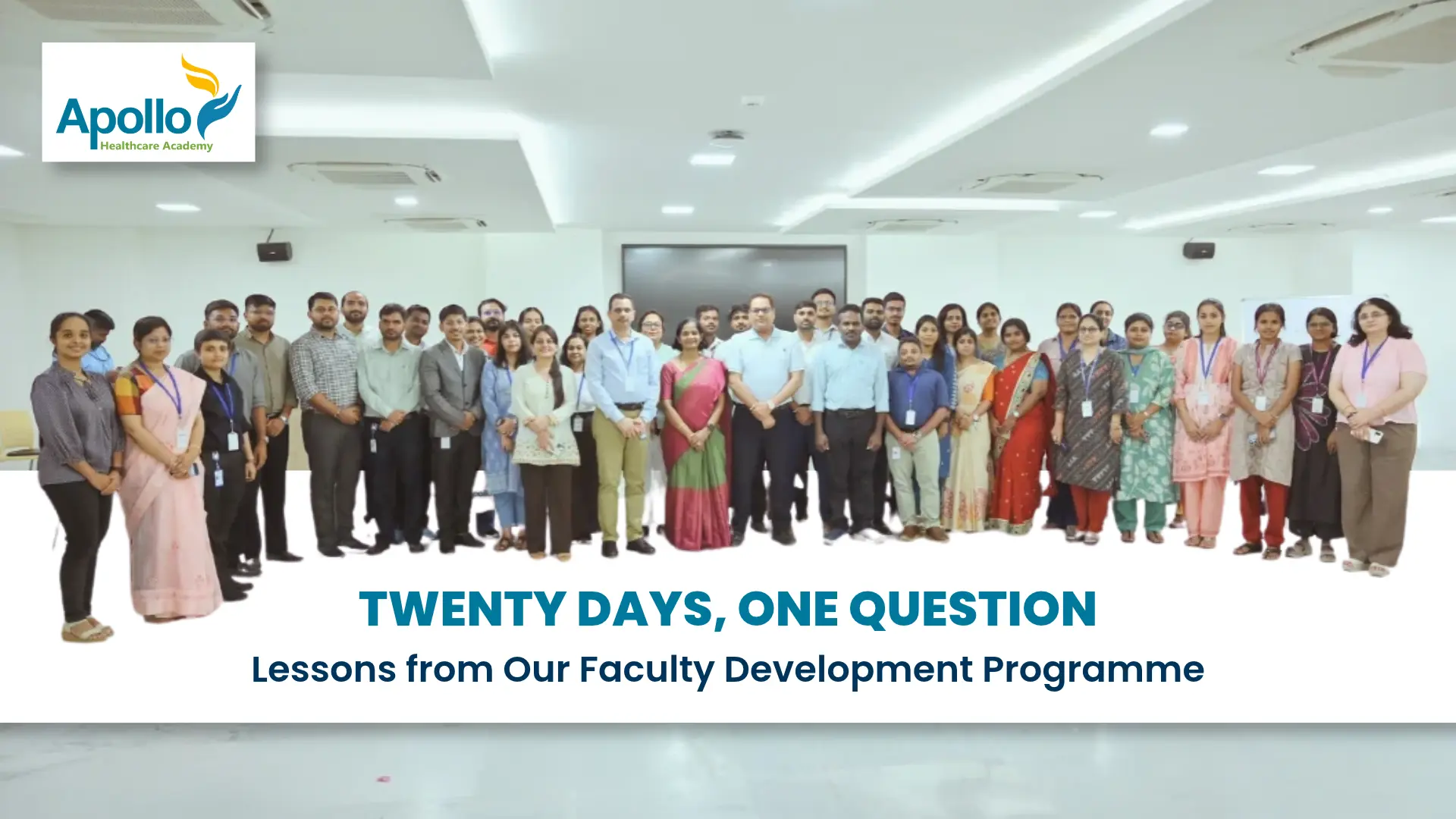


Apollo Healthcare Academy (AHA) ran its faculty development programme in allied health in August 2026, with FlyHigh Educational Excellence Services, Bengaluru. Every session began with one question: what should students be able to do after learning this?
More than forty educators from ten partner institutions spent twenty training days together: one week face to face at The Apollo University, Chittoor campus (3–7 August), then three weeks online, ending with the valedictory on 28 August. This post sets out what they learned and what they committed to take back to their classrooms.
| At a glance | |
| Programme | Faculty Development Programme (FDP) on outcome-based and competency-based education |
| Run by | Apollo Healthcare Academy with FlyHigh Educational Excellence Services, Bengaluru |
| When | 3–28 August 2026 |
| Format | Four weeks, 20 training days: 1 week in person, 3 weeks online |
| In-person week | 3–7 August 2026, The Apollo University, Chittoor campus |
| Participants | More than 40 educators from 10 partner institutions |
| Main topics | OBE, CBE, CO–PO mapping, attainment, Miller’s Pyramid, active learning, AI in teaching, microteaching |
Why Outcome-Based Education in Allied Health Goes With Competency-Based Education
The National Commission for Allied and Healthcare Professions (NCAHP) Act, 2021 and the National Education Policy (NEP) 2020 point allied health education towards defined competencies. If you want the background on the Act, read our note on the role of NCAHP and state councils. Two approaches show how to get there.
Outcome-based education (OBE) begins with what a graduate should be able to do, then builds the curriculum, the teaching and the exams backwards from that. Competency-based education (CBE) asks students to show, in a real or simulated task, that they can do it to the required standard. In a clinical subject the two belong together. An outcome says what the student must achieve, and a competency check shows whether they have.
Week 1 on Campus: Quality by Design, Bloom’s Taxonomy and Measurable Outcomes
The in-person week at Chittoor covered Quality by Design, the principle that quality is built into a curriculum, not checked afterwards. It moved on to Bloom’s Revised Taxonomy, graduate attributes and measurable course outcomes (COs). A measurable outcome uses a verb you can observe, such as perform, interpret or calculate, rather than a vague one such as understand.
Bedside teaching was demonstrated through Peyton’s four-step approach, SNAPPS and Miller’s Pyramid, with a district hospital and laboratory visit.
Week 2 Online: Writing Course Outcomes and Linking Them to Programme Outcomes
In Week 2 participants wrote COs, linked each to a programme outcome (PO), mapped exam questions back to them and calculated attainment. Model POs were drafted for B.Sc. Medical Laboratory Technology and B.Sc. Respiratory Therapy Technology, and 24 teaching–learning methods were matched to their best uses.
CO–PO Mapping and Attainment, Explained
A course outcome says what a student can do after one course. A programme outcome says what a graduate can do after the whole degree. CO–PO mapping puts each CO against the POs it supports. Many institutions score every link on a 1–2–3 scale: 3 for a strong link, 2 for a moderate one, 1 for a slight one, and blank where there is none. The result is a grid that shows which programme outcomes a course covers and which it leaves out.
Attainment asks whether students actually reached each outcome. Direct evidence comes from tests, assignments and practical exams. Indirect evidence comes from surveys, such as an exit survey. The department sets its own target and decides how much weight each kind of evidence carries. In the programme, every calculation ended in an action plan, so a low result led to a change in teaching and not just a figure in a file.
Miller’s Pyramid: Why a Written Test Is Not Enough
Miller’s Pyramid (1990) describes four levels of clinical competence: knows, knows how, shows how and does. Take drawing a blood sample. A student can list the steps, explain why each matters, carry them out on a simulator, and finally do it on a ward with a patient. A written test reaches the first two levels. A simulation or practical exam reaches the third. Only observation at work shows the fourth, which is why a written test alone cannot show what a learner does with a patient.
Learning by Doing: Active-Learning Methods
Facilitators mostly taught each method by using it, not by describing it. Teams built Bloom’s six levels from balloons, straws and tape. Gallery walks, think–pair–share, Crazy 8 ideation and escape-room design ran alongside 30+ digital and artificial intelligence (AI) tools, such as Padlet, Slido and Kahoot.
Week 3 Online: The Programme’s Rule for AI in Teaching
Week 3 put AI to work: prompt writing, case-based learning, multiple-choice items, Objective Structured Clinical Examination (OSCE) rubrics and flipped classrooms. One rule guided it: a tool should reduce cognitive load, not cognitive effort. Handing over the mechanical part of a task is fine. Handing over the thinking is not. Our blog on AI in healthcare covers the same point from the student’s side.
The same week introduced the INSPIRE framework (intend, nurture, stimulate, practise, improve, reflect, empower) and triangulation. Direct assessment shows the skill, indirect assessment shows how it is perceived, and one source alone never proves attainment.
Week 4 Online: Microteaching and the Commitments That Followed
Week 4 covered inclusive communication, learner diversity, academic integrity and intellectual property. Then participants taught 10–15 minute microteaching sessions with stated objectives and a formative check. Topics were the biological effects of ionising radiation, competency-based learning, tuberculosis testing, obstructive sleep apnoea, Basic Life Support and acute kidney injury.
Each participant submitted a professional growth portfolio with dated commitments:
- A common CO–PO mapping format across partner campuses
- Competency-based education (CBE) and Quality by Design from the coming session
- Peer-observed microteaching
- An internal position on responsible AI use
- Full outcome mapping of an undergraduate syllabus by November 2026
The closing address asked each participant for just one change, small enough to carry into the next teaching term.
What the Programme Means for Partner Universities and Their Students
The educators came from our partner universities, which offer and award the degrees. A common CO–PO mapping format means programmes taught at different campuses can be checked against the same outcomes. The model POs drafted in Week 2 cover the same subject areas as our Bachelor of Medical Laboratory Science and Bachelor of Respiratory Therapy programmes. Students also learn on the wards and in the labs of our partner hospitals. For the announcement of the programme, see the Faculty Development Program page.
Key Takeaways
- Begin every lesson plan by asking what students should be able to do afterwards.
- Map COs to POs and assessments, and use both direct and indirect evidence before claiming attainment.
- Let AI reduce cognitive load, never the cognitive effort that learning requires.
Reflect and Apply
Choose one topic you will teach this month, such as radiation protection. What should students be able to do afterwards, and how will you check it directly and indirectly?
Quick check: in the programme’s rule for AI, what should a tool reduce, and what must it protect?
Answer: Reduce cognitive load; protect the learner’s cognitive effort.
FAQs
What Is a Faculty Development Programme?
A faculty development programme (FDP) is structured training that helps teachers improve how they teach, assess and use technology. AHA’s FDP in allied health trained educators from partner institutions in outcome-based and competency-based education.
Who Attended AHA’s Faculty Development Programme?
More than forty educators from ten partner institutions took part.
How Long Was the FDP and How Was It Run?
It ran for four weeks (twenty training days) in August 2026. The first week was in person at The Apollo University, Chittoor campus, from 3 to 7 August. The remaining three weeks were online, and the valedictory was on 28 August.
Who Ran the Programme?
Apollo Healthcare Academy ran the programme with FlyHigh Educational Excellence Services, Bengaluru.
What Did the Faculty Development Programme Cover?
Week 1 covered Quality by Design, Bloom’s Revised Taxonomy and measurable outcomes. Week 2 covered CO–PO mapping and attainment. Week 3 covered AI in teaching, the INSPIRE framework and triangulation. Week 4 covered inclusive communication, academic integrity and microteaching.
What Is Outcome-Based Education in Allied Health?
Outcome-based education (OBE) in allied health means deciding what a graduate must be able to do in practice, such as perform a procedure safely or interpret a result, and then planning the teaching and exams backwards from that. Every course outcome links to a programme outcome, and attainment shows whether students reached it.
What Does CO–PO Mapping Mean?
A course outcome (CO) is what a student can do after one course. A programme outcome (PO) is what a graduate can do after the whole degree. CO–PO mapping scores how strongly each CO supports each PO, often on a 1–2–3 scale: 3 for a strong link, 2 for moderate, 1 for slight and blank for none.
What Is Miller’s Pyramid?
Miller’s Pyramid (1990) has four levels of clinical competence: knows, knows how, shows how and does. It helps teachers match assessment to the level. Written tests reach the lower levels, simulations and practical exams reach “shows how”, and observation at work reaches “does”.
What Was the Rule for AI in Teaching?
A tool should reduce cognitive load, not cognitive effort. Handing over the mechanical part of a task is fine. Handing over the thinking is not.
What Did Participants Commit to After the Programme?
Each participant submitted a professional growth portfolio with dated commitments: a common CO–PO mapping format across partner campuses, competency-based education and Quality by Design from the coming session, peer-observed microteaching, an internal position on responsible AI use, and full outcome mapping of an undergraduate syllabus by November 2026.