
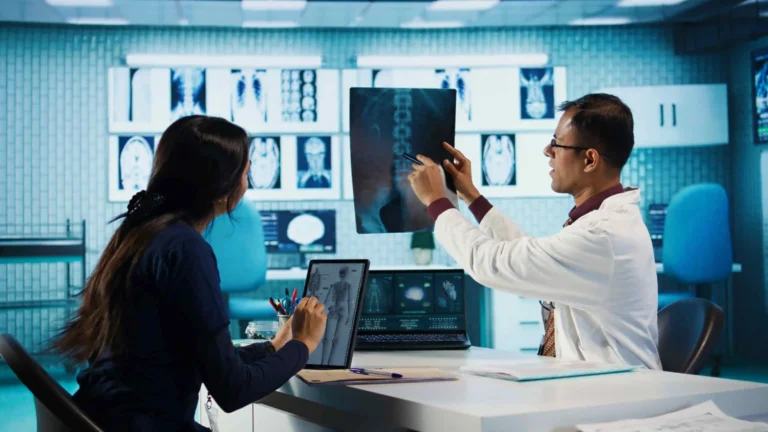
Picture this. You have just completed your allied health degree. You walk into a hospital for your first day as a radiology professional, and the imaging system flags an anomaly on a scan before you have even finished reviewing it. Your senior explains: “That is the AI assistant. Your job is to verify it, put it in clinical context, and decide what to do next.”
This is not a hypothetical. It is already happening in hospitals across India and around the world.
Artificial intelligence has quietly moved from research papers into real clinical environments. It is reading scans, flagging abnormal lab values, predicting which patients are at risk of deterioration, and helping hospitals manage complex workflows more efficiently.
For students choosing a healthcare career today, this changes something important. The question is no longer just “Do I know enough medicine?” It is also “Do I know how to work in a hospital where technology is making decisions alongside me?”
What AI Actually Does in a Hospital Today
Before we talk about skills, it helps to understand where AI is genuinely present in clinical practice right now.
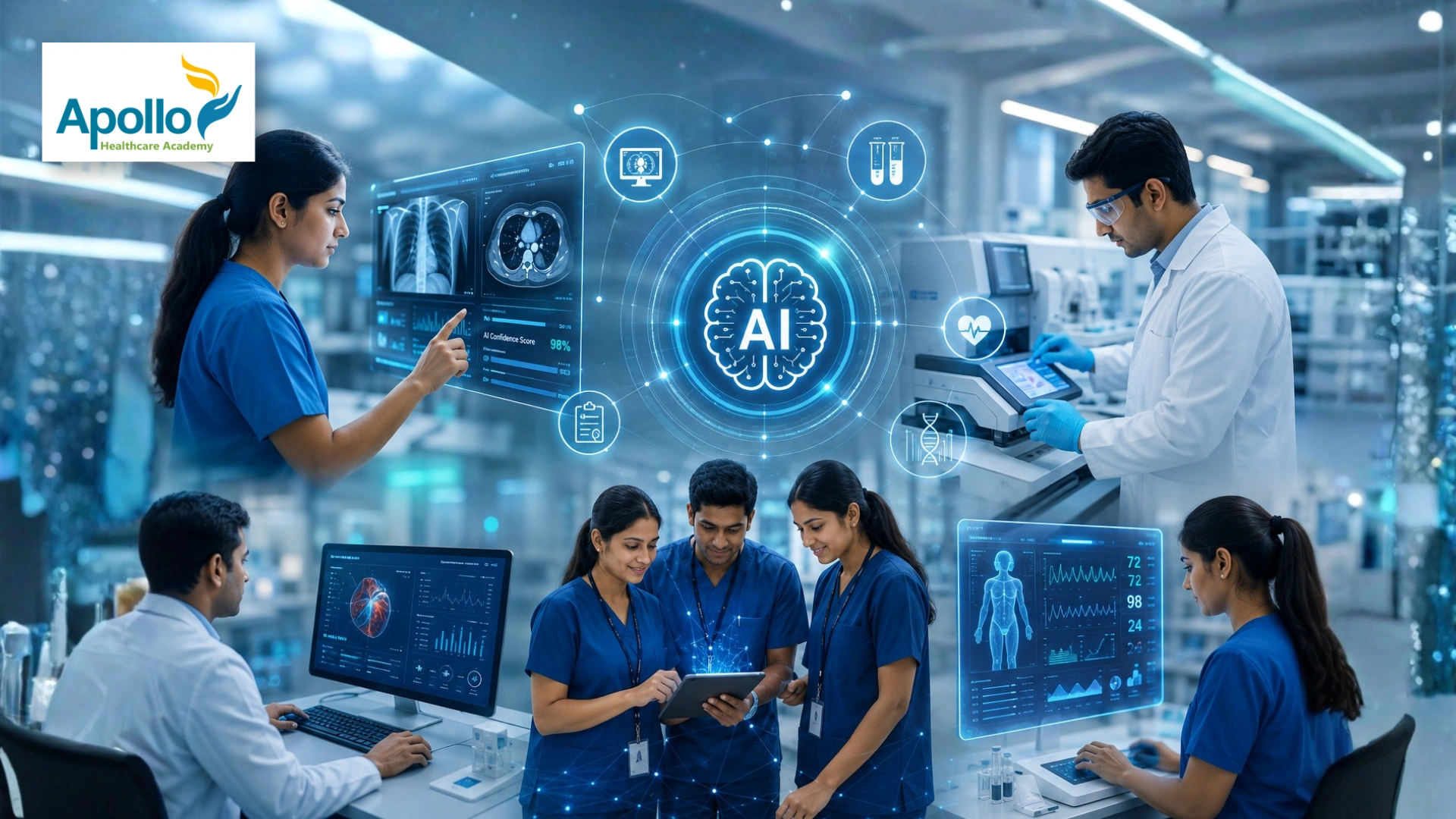
In radiology and imaging: AI tools assist radiologists by scanning X-rays, CT images, and MRIs for patterns associated with disease. They do not replace the radiologist. They act as a second set of eyes, flagging areas that need closer attention. The qualified professional still interprets, verifies, and signs off on every finding.
In medical laboratories: Automated analysers already process thousands of samples with minimal human input. AI-assisted platforms can flag abnormal cell counts, unusual biochemical markers, or patterns that might indicate early-stage disease. The medical laboratory scientist reviews, validates, and acts on those flags.
In cardiac care: AI-powered ECG interpretation tools can detect arrhythmias and subtle cardiac changes. Cardiovascular technologists work alongside these systems, performing procedures, monitoring patients, and applying clinical judgement that no algorithm can replicate.
In critical care and ICUs: Predictive monitoring systems alert teams before a patient deteriorates. Critical care technologists need to understand what these alerts mean, when to act, and when to question the output.
In hospital operations: AI helps manage patient scheduling, resource allocation, and electronic health records. Every healthcare professional interacts with these systems daily, whether they are aware of it or not.
The point is this: AI is not a separate department. It is embedded in the day-to-day work of almost every allied health specialisation.
So Why Is Medical Knowledge Not Enough on Its Own?
Medical and clinical knowledge will always be the foundation of a healthcare career. That has not changed.
What has changed is the environment in which that knowledge is applied.
A radiology student who graduates knowing how to operate an MRI machine but has never worked alongside an AI-assisted imaging platform will face a steep learning curve on day one of employment. A medical laboratory graduate who has only processed samples manually may struggle to validate outputs from AI-driven analysers with confidence.
Healthcare employers are increasingly looking for professionals who can do three things at once: apply clinical knowledge, operate advanced technology, and think critically about whether the technology is right.
That third part is where most traditional healthcare education still falls short.
The Skills That Will Define the Next Generation of Healthcare Professionals
Understanding How the Tools Work
You do not need to know how to build an AI system. But you do need to understand what it is doing, what its limitations are, and when its output should be questioned.
A cardiovascular technologist who understands that an AI ECG tool has a known limitation in detecting certain rare arrhythmias will catch what the algorithm misses. One who accepts every output without question might not. This level of understanding comes from training in modern clinical environments, not from a textbook written before these tools existed.
Interpreting Data, Not Just Collecting It
Every allied health role today involves data. Lab results, imaging reports, patient vitals, monitoring outputs. AI generates more data faster than ever before.
The valuable skill is not data collection. It is knowing what the data means, when something does not look right, and how to translate findings into clear, accurate clinical communication.
Technology Confidence Without Technology Dependence
There is a difference between being comfortable with technology and being dependent on it. The best healthcare professionals use digital tools efficiently while retaining the ability to function, assess, and decide independently.
This confidence comes from exposure. Students who spend their training years working with real clinical equipment in real hospital environments develop a comfort with technology that classroom learning simply cannot provide.
Communication That Bridges the Clinical and the Technical
As healthcare becomes more technology-driven, the ability to explain clinical findings clearly to patients, doctors, and other team members becomes more valuable, not less. Patients do not understand AI outputs. They understand their healthcare professional.
Being able to say “the system flagged this, here is what it means, and here is what we are going to do about it” is a skill that employers actively look for.
Ethical Thinking About Technology in Patient Care
AI in healthcare raises real questions that every professional will eventually face. What happens when an algorithm recommends one course of action and clinical judgement suggests another? How should patient data be handled in AI-assisted systems? Who is responsible when an AI-assisted tool produces an incorrect result?
These are not abstract philosophy questions. They are practical, daily realities in modern clinical work. Healthcare professionals who can think through them clearly are more effective, more trustworthy, and better equipped to advocate for their patients.
What This Means for Students Choosing a Healthcare Programme
If you are a student deciding where to study, the curriculum matters enormously. But so does where and how you train.
A programme that teaches you theory in a classroom and then sends you to a hospital in your final year for the first time is preparing you for a healthcare environment that barely exists anymore. Modern hospitals expect graduates to arrive with genuine clinical readiness, technology familiarity, and the critical thinking skills that only develop through extended, structured exposure.
Look for programmes that integrate practical training throughout all years of study, not just at the end. Look for programmes that are built around modern hospital environments where real technology is in use every single day.
How Apollo Healthcare Academy Prepares Students for AI-Driven Healthcare
At Apollo Healthcare Academy, students learn in a healthcare environment where modern technologies, including AI-powered tools, are already part of everyday clinical practice.
Programs such as Medical Radiology and Imaging Technology (B.MRIT), Cardiovascular Technology (B.CVT), Medical Laboratory Science, Respiratory Therapy, and Critical Care Technology combine strong clinical training with exposure to advanced healthcare technologies. Through hands-on learning, clinical rotations, and hospital-based training, students develop the practical skills, critical thinking, and technology confidence needed for today’s healthcare careers.
The focus is simple: helping students become industry-ready professionals who can work effectively in modern healthcare settings.
A Practical Starting Point
If you are a student preparing to enter healthcare, here is what you can do right now:
- Choose a programme that offers structured clinical training from early in your course, not just at the end
- Seek out training environments where modern medical technology is actively in use
- Develop a habit of asking “why” about every clinical output, whether it comes from a human or a machine
- Stay curious about how the tools in your specialisation are evolving, because they will continue to change throughout your career
The healthcare professionals who will lead the next decade are not the ones who know the most theory. They are the ones who combine solid clinical foundations with the adaptability, critical thinking, and technology confidence that modern hospitals genuinely need.
Explore Apollo Healthcare Academy’s allied health programmes to find out how integrated, hospital-based training can prepare you for the full reality of a career in modern healthcare.