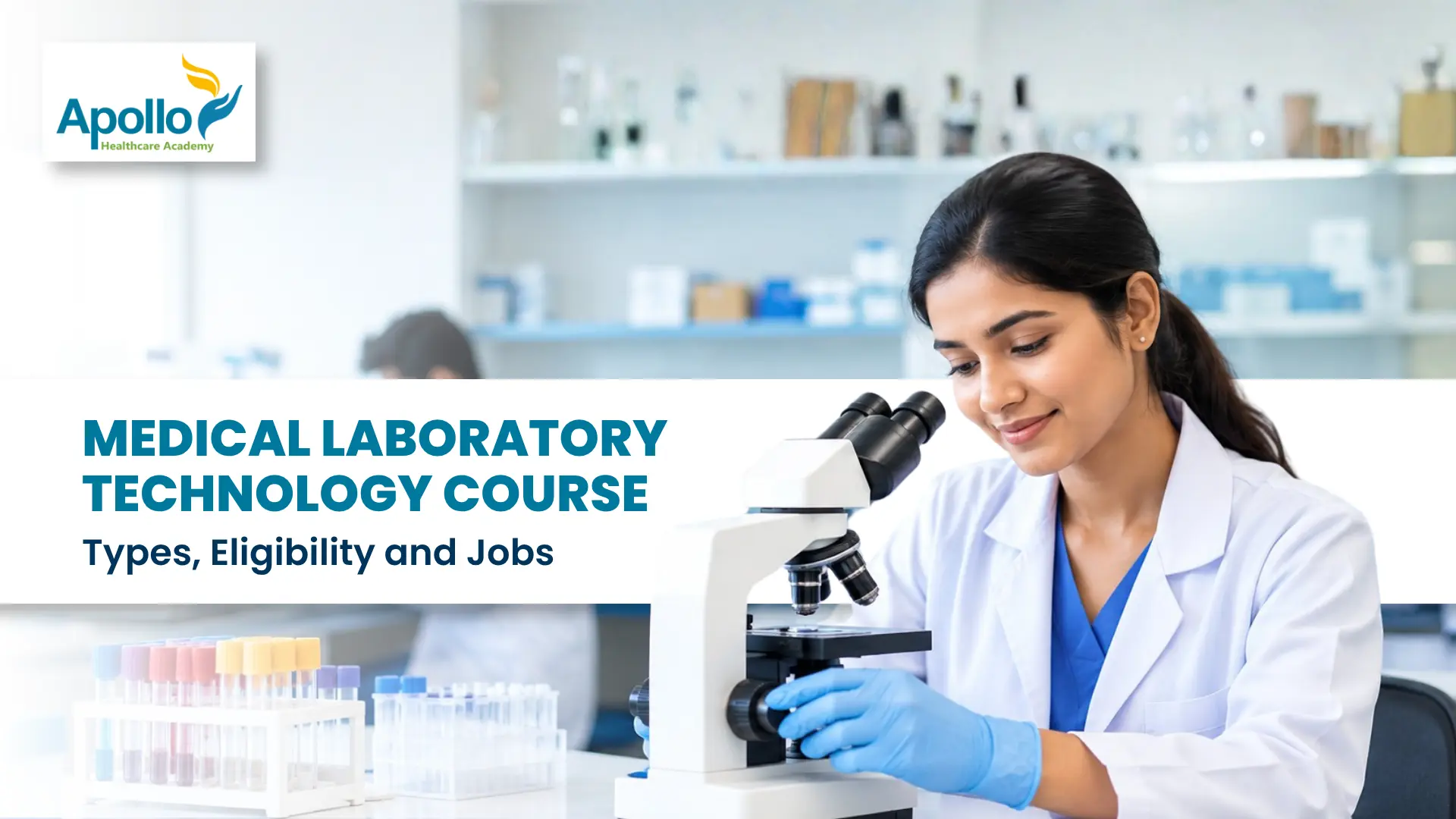


A medical laboratory technology course trains you to run the tests that doctors rely on to diagnose illness, from blood counts to infection checks. MLT stands for Medical Laboratory Technology. You can study it as a certificate, a diploma (DMLT) or a bachelor’s degree, and the entry rules, length and career options are different for each. This guide explains each type, who can join, how long it takes, what you study, what it costs at Apollo Healthcare Academy, and the jobs you can take up afterwards.
MLT courses at a glance
| Certificate (CMLT) | Diploma (DMLT) | Bachelor’s (BMLT, BSc MLT, B.MLS) | |
|---|---|---|---|
| Usual length | 6 months to 1 year | 1 to 2 years | 3 to 4 years |
| Usual entry | Class 10 or Class 12, depending on the college | Class 10 or Class 12 science, depending on the college | Class 12 with Physics, Chemistry and Biology |
| Leads to | Support roles in a lab | Lab technician roles | Technologist roles and a master’s degree |
Length and entry rules change from one college to another, so check them for the college you plan to apply to.
What is a medical laboratory technology course?
It is a paramedical course that teaches you to collect, handle and test samples such as blood, urine and tissue, and to report the results correctly. Colleges use different names for similar courses: MLT, BMLT, BSc MLT, B.MLS (Bachelor of Medical Laboratory Science) and lab technician course. Look at the syllabus and the training on offer, not only the name.
What does a medical lab technician do?
A lab technician works behind the scenes of almost every diagnosis. A normal day can include:
- Collecting and labelling samples, or receiving them from wards and collection centres
- Preparing samples and running tests on laboratory machines
- Checking results for errors and sending reports to doctors
- Keeping records and following safety and infection-control rules
- Looking after equipment and running quality checks
The work is split across areas such as biochemistry, haematology, microbiology, pathology, immunology and blood banking.
Types of MLT courses: certificate, diploma and bachelor’s
Certificate in Medical Laboratory Technology (CMLT). The shortest option, usually six months to a year. It teaches basic lab skills such as sample handling and simple tests, and suits people who want to start in a support role quickly.
Diploma in Medical Laboratory Technology (DMLT). The DMLT course is the most searched route into the field. It usually runs for two years and often includes practical training in a lab. It prepares you for lab technician work. Some universities allow diploma holders to join a bachelor’s course in the second year, but the rules differ, so ask the university.
Bachelor’s in Medical Laboratory Technology (BMLT, BSc MLT or B.MLS). A three- to four-year degree with more theory, more lab work in each area and longer clinical training. It is the base for a master’s degree and for technologist-level roles. The Our medical laboratory degree at Apollo Healthcare Academy is a four-year course of this kind.
Master’s. An MSc in medical laboratory technology or medical laboratory sciences is for people who want to teach, do research or lead a laboratory.
DMLT or a bachelor’s degree: which should you choose?
Choose a diploma if you want to start working in a lab sooner. Choose a bachelor’s if you are happy to study longer for wider training in every lab area and a degree you can build on with a master’s. If you are not sure, ask the college whether diploma students can move into the degree later and on what terms.
Eligibility for a medical laboratory technology course
The rules depend on the level and the college:
- Certificate and diploma: some colleges accept students after Class 10, others ask for Class 12 science. Minimum marks are usually around 45% to 50% where they are asked for.
- Bachelor’s: Class 12 with Physics, Chemistry and Biology, with a minimum percentage set by the college. The usual minimum age is 17.
- Selection: some colleges admit on Class 12 marks, others hold an entrance test.
Eligibility for the B.MLS at Apollo Healthcare Academy
- Class 12 (10+2) with Physics, Chemistry and Biology
- At least 50% in Class 12 with those subjects
- Age 17 by 31 December of the admission year
- Students from a PCM background who take Biology as an additional subject can also apply
Check the latest rules on the Apollo Healthcare Academy admissions page before you apply.
How long is an MLT course?
A certificate usually takes six months to a year, a diploma one to two years, and a bachelor’s three to four years. Our Bachelor of Medical Laboratory Science runs for four years across eight semesters. The last two semesters are compulsory rotatory internships, along with a research project.
What do you study in an MLT course?
Most MLT courses cover the same core areas: anatomy and physiology, biochemistry, microbiology, pathology, haematology, immunology, blood banking, and laboratory management and quality control. Safety and record keeping run through all of them, and the better courses put students in a real lab early.
This is the semester-wise subject list for our B.MLS:
| Semester | Subjects |
|---|---|
| I | Human Anatomy, Human Physiology, Medical Terminology and Record Keeping, Introduction to Healthcare Delivery System in India, Communication Skills, Computer Applications in Healthcare, Environmental Sciences, Fundamentals of Medical Laboratory Science, Basic Emergency Care and First Aid |
| II | Medical Law and Ethics, Psychology, Sociology and Behavioural Sciences, Applied Biostatistics and Research Methods, Community Orientation and Clinical Visit, Professionalism and Values, Constitution of India and Human Rights, Indian Knowledge Systems in Health and Wellness, Biochemistry, Microbiology, Fundamentals of Haematology, Preventive and Social Medicine |
| III | Bacteriology, Intermediary Metabolism and Endocrinology, Clinical Haematology, Immunohematology and Transfusion Medicine, Clinical Training I (Observational), Basic Pharmacology, Research Design and Methodology |
| IV | Virology and Immunology, Genetics and Molecular Biology, Clinical Pathology, Medical Laboratory Management and Quality Control, Clinical Training II (Observational), Data Collection and Sampling Methods |
| V | Mycology and Parasitology, Analytical Biochemistry, Advanced Immunohematology and Transfusion Medicine, Healthcare Quality and Patient Safety, Clinical Training III (Hands-on), Data Analysis and Interpretation |
| VI | Applied Pathobiology, Cytology and Histopathology, Clinical Biochemistry, Clinical Training IV (Hands-on), Research Communication and Scientific Writing |
| VII | Compulsory Rotatory Internship I, Research Project |
| VIII | Compulsory Rotatory Internship II, Research Project Dissertation |
Clinical training begins with observation in semesters III and IV, moves to hands-on work in semesters V and VI, and the final two semesters are rotatory internships. The curriculum can be updated, so confirm the current list with the admissions team.
MLT course fees
Fees depend on the level, the college and whether it is government or private, so one figure for all MLT courses would mislead you. Ask every college for its full fee structure in writing, including exam, lab and hostel charges and its refund rules.
At Apollo Healthcare Academy, the tuition fee for the Bachelor of Medical Laboratory Science is ₹2.5 lakh per annum.
Scholarships are tuition fee waivers based on a composite score: half from the AHA Scholarship Test and half from your Class 12 aggregate. A score of 95 and above earns a 25% waiver, 90 to 94.99 earns 15%, and 85 to 89.99 earns 10%. Awards go in order of score until 10% of the intake is filled, so reaching a slab does not guarantee a waiver. The rules for the 2026-27 session are on the scholarship page. For what the fee includes and how to pay it, speak to the admissions team.
Bachelor of Medical Laboratory Science at Apollo Healthcare Academy
The Bachelor of Medical Laboratory Science at Apollo Healthcare Academy is a four-year programme that combines classroom learning with training in hospital laboratories. It covers clinical biochemistry, haematology, microbiology, immunology, cytology and molecular biology, with quality control and laboratory safety taught alongside.
Our partner universities offer and award the degree, and Apollo Healthcare Academy provides the clinical training and career support. We add new centres from time to time, so check that page for the current list. You can also see all our degrees on the programmes page and the partner hospitals we work with.
We give students job and placement support. It helps you prepare and connect with employers, but it does not guarantee a job. The admissions team can explain how it works.
If you would rather work in the operation theatre than in the lab, look at the Bachelor of Anaesthesia and Operation Theatre Technology.
What to check before you join any MLT course
- Who awards the certificate, diploma or degree, and whether the course is recognised.
- Where the hands-on training happens, when it starts and who supervises it.
- Whether an internship is included in the course length and the fee.
- The semester-wise syllabus, in writing, not only a list of subject areas.
- The total fee, with every charge and the refund rules.
- What placement support means. Ask what the college actually does, and be careful with promises of a guaranteed job.
Jobs after a medical laboratory technology course
Graduates of our B.MLS can work as:
- Medical Laboratory Scientist
- Clinical Biochemist Associate
- Microbiology Technologist
- Haematology Technologist
- Molecular Diagnostics Associate
- Histopathology and Cytology Technologist
- Laboratory Quality Coordinator
Diploma and certificate holders usually start as lab technicians or assistants. Roles are found in hospital laboratories, diagnostic labs, blood banks, research labs and public health labs. Government hospitals and health departments recruit through their own notifications and set their own qualification rules, so read each notification before you apply.
If you want to study further, you can do a master’s in medical laboratory sciences, or move towards clinical research, public health laboratory work or healthcare management.
Is a medical laboratory technology course right for you?
A medical laboratory technology course suits you if you like science, careful work and being part of a hospital team without working directly with patients all day. Pick the level that fits your qualification and your plans, compare the syllabus and training before you decide, and ask the college for everything in writing. Read the full B.MLS programme details, or speak to the team through the admissions page.
Frequently asked questions
What is the full form of MLT?
MLT stands for Medical Laboratory Technology. DMLT is Diploma in Medical Laboratory Technology, CMLT is Certificate in Medical Laboratory Technology, and BMLT is Bachelor of Medical Laboratory Technology.
Can I do an MLT course after 12th?
Yes. After Class 12 science you can join a diploma or a bachelor’s course. Most colleges ask for Physics, Chemistry and Biology for the bachelor’s. For our Bachelor of Medical Laboratory Science you need Class 12 with Physics, Chemistry and Biology and at least 50%.
Can I do an MLT course after 10th?
Some colleges offer certificate and diploma courses after Class 10, while others ask for Class 12 science, so check the rules of the college you like. Our B.MLS is a bachelor’s degree, so it needs Class 12.
How many years is the MLT course?
A certificate usually takes six months to a year, a diploma one to two years and a bachelor’s three to four years. Our B.MLS takes four years, including rotatory internships.
What is the fee for the medical laboratory degree at Apollo Healthcare Academy?
The tuition fee is ₹2.5 lakh per annum. Scholarships are available on a composite score, and the rules are on our scholarship page. The admissions team can tell you what the fee includes.
Which is better, DMLT or a bachelor’s in MLT?
Neither is better for everyone. A diploma is shorter and gets you into lab work sooner. A bachelor’s takes longer, gives wider training and is the base for a master’s degree. Pick the one that fits your qualification, time and plans.
Is B.MLS the same as BMLT or BSc MLT?
Colleges use these names for similar courses. B.MLS stands for Bachelor of Medical Laboratory Science. What matters more than the name is the syllabus, the hospital training and who awards the degree.
Does Apollo Healthcare Academy give placement support?
Yes. We give students job and placement support. It does not guarantee a job, and the admissions team can explain how it works.
Does Apollo Healthcare Academy offer a diploma in medical laboratory technology?
Our medical laboratory programme is the four-year Bachelor of Medical Laboratory Science. For questions about diploma or certificate options or lateral entry, the admissions team can tell you what is available.