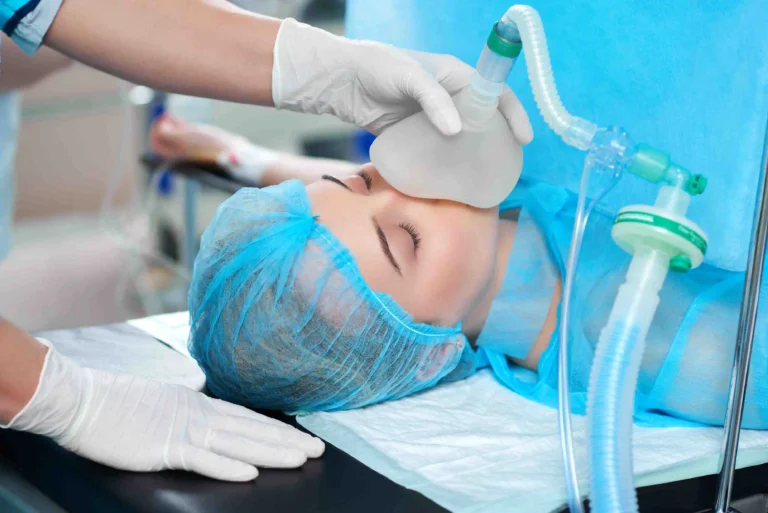
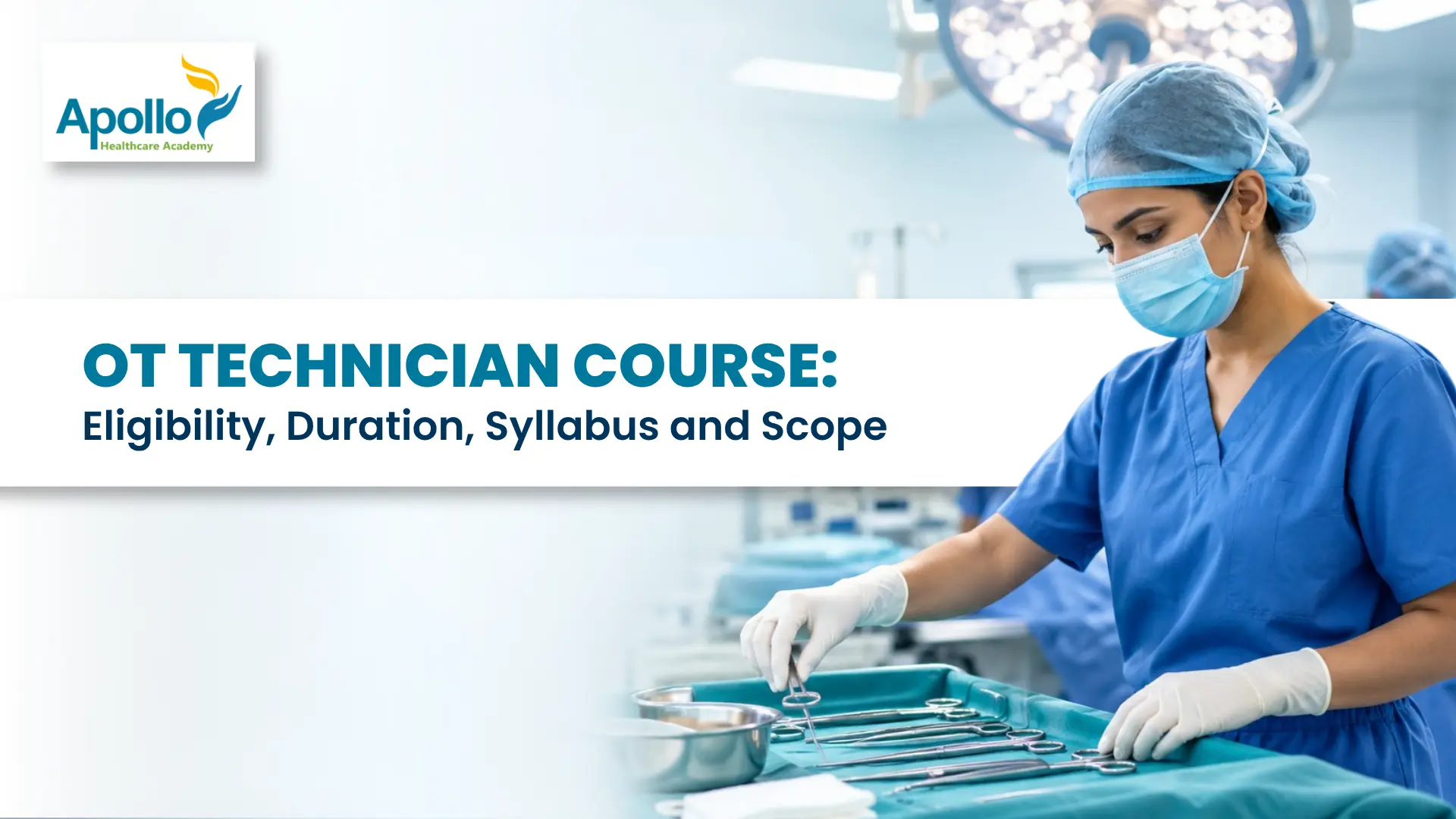


An OT technician course trains you to work inside the operation theatre. You learn to prepare the theatre, handle sterilised instruments and equipment, and support the surgeons and the anaesthesia team during an operation. OT stands for operation theatre. You can study this field as a certificate, a diploma or a bachelor’s degree, and which one suits you depends on your marks, your stream and how far you want to go in the field.
This guide explains each route in plain terms: who can apply, how long it takes, what you study, what it costs, and what work you can do afterwards. It also covers the four-year B.AOTT degree at Apollo Healthcare Academy.
OT technician course at a glance
| Certificate | Diploma | Bachelor’s degree | |
| Usual duration listed by institutes | 6 months to 1 year | 1 to 2 years | 3 years plus internship at some universities (4 years at Apollo Healthcare Academy) |
| Usual entry | Often 10th pass, but it varies | 10th or 12th pass, depending on the institute | 12th with science subjects |
| Best for | A quick start in a support role | A shorter route into the OT team | A longer, more detailed training with more hospital time |
These ranges come from what institutes publish. They are not fixed rules, and they differ from one institute and university to another. Always check the course details with the institute you plan to join.
What is an OT technician course?
An OT technician course is a healthcare training programme for people who want to work in operation theatres. The OT technician is part of the surgical team, but does not perform the surgery. Their work is to keep the theatre ready, safe and clean, and to make sure the right equipment and instruments are available at the right time.
You may also see the same field called operation theatre technology, OTT, or anaesthesia and operation theatre technology. In degree form, the names include B.Sc. in Operation Theatre Technology and B.Sc. in Anaesthesia and Operation Theatre Technology. At Apollo Healthcare Academy, our degree is the Bachelor of Anaesthesia and Operation Theatre Technology (B.AOTT).
What does an OT technician do?
Tasks differ from hospital to hospital and depend on your training, but the day usually includes:
- Getting the operation theatre ready before surgery: checking the lights, table, suction and other equipment
- Preparing sterilised instruments and sets for each procedure
- Helping to position the patient on the operating table with the team
- Supporting the surgeon and the nurses during the operation
- Helping the anaesthesia team with their equipment
- Cleaning, disinfecting and restocking the theatre after each case
- Following infection control and safety rules, including handling of used instruments and medical waste
OT technician course types: certificate, diploma and degree
Certificate courses are the shortest. Institutes usually list them at 6 months to 1 year. They cover basics such as sterilisation, instruments and theatre hygiene, and mostly lead to support roles. Some short courses use names like OT assistant course, so check the level and duration before you apply.
Diploma courses (for example a diploma in OT technician or a diploma in operation theatre technology) are usually listed at 1 to 2 years. Some include a period of training in a hospital.
Bachelor’s degrees such as the B.Sc. in Operation Theatre Technology or the B.Sc. in Anaesthesia and Operation Theatre Technology take longer, usually three to four years including internship. They go deeper into anatomy, anaesthesia and surgical care, and carry more hospital training.
Longer courses usually include more hospital training, but check how much. That matters, because this is a hands-on job.
OT technician course eligibility
Eligibility depends on the level and the institute:
- Certificate: often 10th pass, though some institutes ask for 12th.
- Diploma: institutes differ. Some accept 10th pass, others ask for 12th, and some want science subjects.
- Bachelor’s degree: 12th pass with Physics, Chemistry and Biology from a recognised board is the usual requirement. Many institutes also set a minimum percentage and a minimum age of 17.
At Apollo Healthcare Academy (B.AOTT): candidates need 10+2 with Physics, Chemistry and Biology (PCB) or Physics, Chemistry, Mathematics and Biology (PCMB) from a recognised board, with at least 50% marks in Physics, Chemistry and Biology, and must be at least 17 years old by 31 December of the year of admission. Admission is based on 10+2 marks, and no entrance test is needed. Diploma holders in anaesthesia and operation theatre technology can apply for lateral entry into the second year, subject to university norms. Our admissions team can explain how this works in your case.
Check the latest rules on the Apollo Healthcare Academy admissions page before you apply.
OT technician course duration
The OT technician course duration depends on the level:
- Certificate: about 6 months to 1 year
- Diploma: about 1 to 2 years
- Bachelor’s degree: 3 years plus a year of internship at some universities
The B.AOTT at Apollo Healthcare Academy runs for four years, including an internship and hospital residency in the final year. Internship availability depends on the institution and our healthcare partners, so ask the admissions team how it works for your batch.
When you compare courses, ask whether the stated duration already includes the internship. Some institutes quote the classroom years and add the internship separately.
OT technician course syllabus
Syllabus differs by institute, but most OT technician courses include these subject areas:
- Human anatomy and physiology
- Medical terminology
- Microbiology and infection control
- Sterilisation and the central sterile supply department (CSSD)
- Operation theatre equipment and instruments
- Basics of anaesthesia and anaesthesia equipment
- Pre-operative and post-operative care
- Patient positioning and safety
- Basic life support, first aid and emergency care
- Biomedical waste handling
- Communication and professional ethics
Degree programmes add more depth in each of these areas, and some add research methods and a project.
What you study in the B.AOTT at Apollo Healthcare Academy: the degree runs for eight semesters over four years. This is the semester-wise course list.
| Semester | Subjects |
| I | Human Anatomy; Human Physiology; Biochemistry; Medical Terminology & Record Keeping; Introduction to Healthcare Delivery System in India; Communication Skills; Computer Applications in Healthcare; Introduction to Anaesthesia & OT Environment; Health Care Quality & Patient Safety |
| II | Medical Law & Ethics; Psychology, Sociology & Behavioural Sciences; Applied Biostatistics & Research Methods; Community Orientation & Clinical Visit; Professionalism & Values; Constitution of India & Human Rights; Environmental Sciences; Indian Knowledge Systems in Health & Wellness; Pathology; Microbiology; Basics of Surgical & Anaesthesia Sciences |
| III | Basic Pharmacology; Hematology; Basic Techniques of Anaesthesia; Basics of Surgical Procedures; CSSD & Manifold Area; Clinical Observation-I; Research Design & Methodology |
| IV | Advanced Anaesthesia Techniques; Advanced Surgical Procedures; Basic Intensive Care; Clinical Medicine & Related Management; Clinical Observation-II; Data Collection & Sampling Methods |
| V | Specialized Anaesthesia-1; Specialized Surgery-1; Recent Advances in Anaesthesia & Surgical Field; Community Medicine; Clinical Training-I (Hands-on); Data Analysis & Interpretation |
| VI | Specialized Anaesthesia-2; Specialized Surgery-2; Specialized Anaesthesia & Surgery-3; Clinical Training-II (Hands-on); Research Communication & Scientific Writing |
| VII | AOTT Internship-I; Applied Research & Audit Project-AOTT I |
| VIII | AOTT Internship-II; Applied Research & Audit Project-AOTT II |
Clinical work builds up through the course. You start with clinical observation in semesters III and IV, move to hands-on clinical training in semesters V and VI, and complete two internships in semesters VII and VIII. Subjects may be updated from time to time, so ask the admissions team for the latest list.
OT technician course fees
The OT technician course fees vary a lot. A short certificate course costs far less than a full degree, and government and private institutes charge differently. Fees also change from year to year. We are not quoting an average because published averages are rarely sourced.
At Apollo Healthcare Academy, the tuition fee for the B.AOTT is ₹2.5 lakh per annum. We also offer merit-based tuition fee waivers (the policy below is for the 2026-27 session). The waiver depends on a composite score, which is 50% of your AHA Scholarship Test score plus 50% of your Class 12 aggregate percentage. A composite score of 95 and above gets a 25% tuition fee waiver, 90 to 94.99 gets 15%, and 85 to 89.99 gets 10%. Waivers are given in order of composite score until the scholarship allocation (10% of the intake) is filled, so meeting the score does not guarantee a waiver. You need to take the AHA Scholarship Test to be considered for it. Admission itself is based on 10+2 marks and needs no entrance test. The partner university awards and administers the scholarship. See our scholarship page for the full policy, and ask the admissions team what the fee covers.
When you compare fees across institutes, ask for the total for the whole course, not just one year or one semester.
B.AOTT at Apollo Healthcare Academy
If you want the degree route, the Bachelor of Anaesthesia and Operation Theatre Technology at Apollo Healthcare Academy is a four-year programme that combines classroom learning with training in hospitals. Our partner universities offer and award the degree, and Apollo Healthcare Academy provides the clinical training and career support. We add new centres from time to time, so check that page for the current list. You can also see all our degrees on the programmes page and the partner hospitals we work with.
B.AOTT graduates can work in these roles, with the work each involves: Operation Theatre Technologist (OT setup, instrument management and keeping the sterile field), Anaesthesia Technologist (anaesthesia equipment, patient monitoring and support during surgery), Surgical Support Executive (technical support during trauma and emergency surgery), OT Assistant (assisting the surgeon, patient positioning and documentation), Perioperative Care Technologist (care before and after surgery and recovery monitoring) and OT Coordinator (theatre scheduling, team coordination and supply management). We also provide job and placement support to our students. These are career tracks, and placement support does not guarantee a job.
If you already hold a diploma in anaesthesia and operation theatre technology, you may be able to join the second year through lateral entry, subject to university norms. Ask the admissions team for details.
What to check before you join any OT technician course
Before you pay any fee, find out:
- Who awards the certificate, diploma or degree? It should be a recognised university or institution.
- How much hospital training is included, and where? For a hands-on job, this matters more than almost anything else.
- Is the internship part of the course fee and duration, or extra?
- What is the total fee for the whole course? Include any hostel, exam and uniform costs.
- What do past students do after the course? Ask for real examples, not general promises.
- Is the syllabus year-wise and in writing?
Scope and careers after an OT technician course
Operation theatres run in hospitals, surgical centres and day-care centres, so these are the places where OT technicians work. The roles you can apply for depend on your level of training:
- OT technician or operation theatre technologist
- OT assistant
- Anaesthesia technician or anaesthesia technologist
- OT coordinator
With experience, some people move into supervisory and coordination roles in the OT. Some degree holders also go on to a master’s programme in a related field.
Some graduates look at jobs abroad. Those roles usually need extra exams or licensing in the country, so check the rules of that country first.
Salary depends on the hospital, the city, your training level and your experience. We are not quoting salary figures here because the numbers published online vary widely and are rarely sourced.
Frequently asked questions
What is the OT technician course? It is a training programme, at certificate, diploma or degree level, for people who want to work in operation theatres. You learn to prepare the theatre, handle sterile instruments and equipment, and support the surgical and anaesthesia teams.
Can I become an OT technician after 12th? Yes. After 12th you can join a diploma or a degree course. Most degree courses ask for science subjects, usually Physics, Chemistry and Biology.
Can I do the OT technician course after 10th? Some institutes offer certificate or diploma courses after 10th, but others ask for 12th. It depends on the institute, so check the eligibility before you apply.
How long is the OT technician course? Certificate courses are usually 6 months to 1 year, diplomas 1 to 2 years, and degrees three to four years including internship. The B.AOTT at Apollo Healthcare Academy is four years.
What are the OT technician course fees? It depends on the level and the institute. Ask for the full course fee. At Apollo Healthcare Academy, the tuition fee for the B.AOTT is ₹2.5 lakh per annum. The admissions team can tell you what the fee covers.
Is the anaesthesia technician course the same as the OT technician course? The two fields overlap, since OT technicians and anaesthesia technicians work in the same theatre. Some courses, including the B.AOTT, cover both.
What is the difference between an OT technician and an OT assistant? The two names are often used loosely, and what they mean depends on the hospital and the course. Check the exact duties and training level that a course or a job description lists.
Does Apollo Healthcare Academy provide placement support? Yes. We provide job and placement support to our students. It does not guarantee employment, and career progress depends on your performance, experience and market conditions. Ask the admissions team how it works.
Does Apollo Healthcare Academy offer a diploma in OT technology? Our programme is the four-year B.AOTT degree. If you already hold a diploma in anaesthesia and operation theatre technology, ask the admissions team about lateral entry into the second year.
Want to study OT technology at Apollo Healthcare Academy?
Read the full B.AOTT programme details, or speak to the team through the admissions page.