
A radiology course trains you to work with the imaging that doctors use to look inside the body: X-ray, CT, MRI and ultrasound. After Class 12 with science you can study it as a certificate, a diploma or a bachelor’s degree. Which one you choose decides how long you study and which jobs you can apply for. Becoming a radiologist, the doctor who reads the scans, is a different route that starts with MBBS.
This guide explains the types of radiology course, who can apply, how long each takes, what you study, what it costs and what work you can do afterwards. It also covers the four-year Bachelor of Medical Radiology and Imaging Technology at Apollo Healthcare Academy.
Radiology course at a glance
| Certificate | Diploma | Bachelor’s degree | |
|---|---|---|---|
| Usual duration listed by institutes | 6 months to 1 year | 1 to 2 years | 3 to 4 years, with the internship included at some institutes and added at others (4 years at Apollo Healthcare Academy) |
| Usual entry | 10+2 with science, though some institutes accept 10th pass | 10+2 with science at most institutes | 10+2 with Physics, Chemistry and Biology |
| Best for | A quick start in a support role | A shorter route into imaging | Broader training, more hospital time and the base for further study |
These ranges come from what institutes publish. They are not fixed rules, and they differ from one institute and university to another. Always check the course details with the institute you plan to join.
What is a radiology course?
Radiology is the branch of medicine that uses imaging to find and follow disease and to guide some treatments. A radiology course teaches you to run the imaging machines, take clear images safely and look after the patient during the scan. The imaging includes X-ray, CT, MRI and ultrasound, and some courses add nuclear medicine and mammography.
The same field goes by several names, so a search can show many titles for one kind of course: radiology, radiography, medical imaging technology, and medical radiology and imaging technology. At Apollo Healthcare Academy, our degree is the Bachelor of Medical Radiology and Imaging Technology (B.MRIT).
What does a radiology technologist do?
The tasks differ from hospital to hospital and depend on your training, but a day usually includes:
- Explaining the scan to the patient and checking they are ready for it
- Positioning the patient correctly for the X-ray, CT, MRI or ultrasound
- Operating the imaging equipment and taking the images
- Following radiation safety rules to protect the patient and the team
- Recording patient details and the images, and passing them to the radiologist
- Checking that the equipment works properly and reporting faults
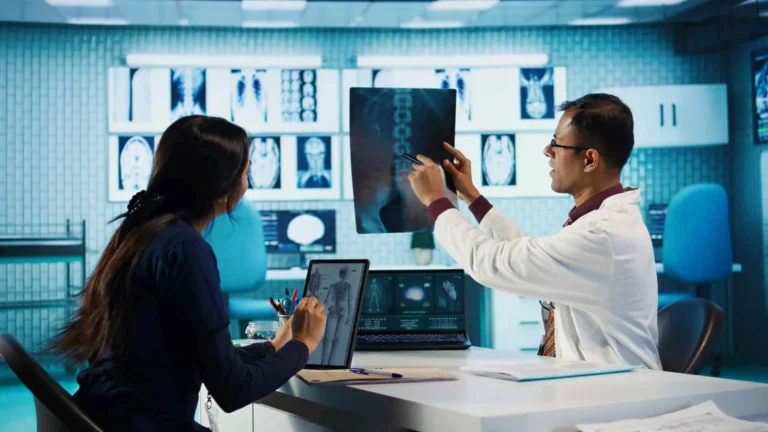
The technologist takes the images. The radiologist, a doctor, studies them and writes the report.
Types of radiology courses: certificate, diploma, bachelor’s and master’s
Certificate courses are the shortest. Institutes usually list them at 6 months to 1 year. They cover basics such as positioning and handling X-ray equipment, and mostly lead to support roles.
Diploma courses, such as a diploma in radiology, a diploma in radiography or a diploma in radiology and imaging technology, are usually listed at 1 to 2 years. Some include training in a hospital or imaging centre.
Bachelor’s degrees such as a B.Sc. in Radiology, a B.Sc. in Medical Radiology and Imaging Technology and the B.Voc. in the same field usually take three to four years. They go deeper into anatomy, radiation physics and imaging techniques, and they carry more hospital training. Our B.MRIT at Apollo Healthcare Academy is a four-year course of this kind.
Master’s degrees such as an M.Sc. in Radiology or Medical Imaging Technology take about two years after a bachelor’s degree and suit people who want to specialise, teach or work in management.
You may also see a radiation technology course. Some of these focus on radiotherapy, which uses radiation to treat cancer, rather than on diagnostic imaging. Read the subject list to see which field a course covers.
Radiologist or radiology technologist: which path is yours?
These are two different careers, and the word “radiology” in a search often hides the difference.
A radiologist is a doctor. According to Naukri’s guide, the route is Class 12 with Physics, Chemistry and Biology, then NEET-UG and an MBBS of about 5.5 years including internship, then a postgraduate degree in radiology, which is an MD or a DNB of 3 years. The radiologist reads the scans, diagnoses and, in some cases, performs image-guided procedures. This is the answer to how to become a radiologist after 12th, and it takes many years.
A radiology technologist operates the equipment and takes the images. The route is a diploma or a bachelor’s degree after Class 12, as described in this guide. It takes fewer years, and it does not make you a doctor or let you report scans.
If you are unsure, ask yourself whether you want to diagnose from images or to produce them. Neither is better. They are different jobs with different training.
Eligibility for a radiology course after 12th
Eligibility depends on the level and the institute:
- Certificate: often 10+2, preferably with science, though a few institutes accept 10th pass.
- Diploma: most institutes ask for 10+2 with science. The exact subjects vary.
- Bachelor’s degree: 10+2 with Physics, Chemistry and Biology is the usual requirement. Many institutes also set a minimum aggregate, which differs from one to another, and a minimum age of 17.
At Apollo Healthcare Academy (B.MRIT): candidates need Class 12 with Physics, Chemistry and Biology. Students with Physics, Chemistry and Mathematics who take Biology as an additional subject can also apply. A minimum of 50% aggregate marks from a recognised board is needed, and you must turn 17 by 31 December of the year of admission.
Check the latest rules on the Apollo Healthcare Academy admissions page before you apply.
How long is a radiology course?
The radiology course duration depends on the level:
- Certificate: about 6 months to 1 year
- Diploma: about 1 to 2 years
- Bachelor’s degree: 3 to 4 years, including internship at some institutes
- Master’s degree: about 2 years
The B.MRIT at Apollo Healthcare Academy runs for four years, or eight semesters. The last two semesters are compulsory rotatory internships, along with a research project.
When you compare courses, ask whether the stated duration already includes the internship. Some institutes quote three years of study and add six months of internship on top.
What do you study in a radiology course?
The syllabus differs by institute, but most radiology courses cover these areas: human anatomy and physiology, radiation physics, radiographic positioning and techniques, contrast media and special procedures, CT, MRI and ultrasound basics, patient care, radiation safety and quality checks, and clinical training in a hospital.
The semester plan for the B.MRIT at Apollo Healthcare Academy is below.
| Semester | Subjects |
|---|---|
| I | Human Anatomy; Human Physiology; Fundamentals of Physics and Mathematics; Radiation Physics; Medical Terminology and Record Keeping; Introduction to Healthcare Delivery System in India; Communication Skills; Computer Applications in Healthcare; Radiographic Science and Introduction to Imaging; Principles of Management |
| II | Medical Law and Ethics; Psychology, Sociology and Behavioural Sciences; Applied Biostatistics and Research Methods; Community Orientation and Clinical Visit; Professionalism and Values; Constitution of India and Human Rights; Environmental Sciences; Indian Knowledge Systems in Health and Wellness; Biochemistry; Conventional Radiography and Equipment; Basics of Microbiology; Clinical Radiography Positioning, Part I |
| III | Pathology; Clinical Radiography Positioning, Part II; Radiography and Image Processing Techniques; Contrast Media and Special Radiological Procedures; Radiology Clinical Education, Part III (studentship); Research Design and Methodology |
| IV | Cross Sectional Anatomy; Modern Radiological Imaging Equipment and Physics; Interventional Radiology Techniques; Patient Care in Radiology; Clinical Observation; Data Collection and Sampling Methods |
| V | Basic Techniques in CT Technology; Radiation Safety in Diagnostic Radiology; Quality Assurance in Diagnostic Radiology and Regulatory Requirements; Clinical Training; Data Analysis and Interpretation |
| VI | Basic Techniques in MRI Technology; Introduction to Nuclear Medicine Techniques; Ultrasound Techniques; Radiology Clinical Education, Part V (studentship); Research Communication and Scientific Writing |
| VII | Compulsory Rotatory Internship I; Research Project or Dissertation I |
| VIII | Compulsory Rotatory Internship II; Research Project or Dissertation II |
Clinical work builds up through the course, from clinical education and observation in semesters III and IV to clinical training in semesters V and VI, and two internships in semesters VII and VIII. Subjects may be updated from time to time, so ask the admissions team for the latest list.
Radiology course fees
Fees vary a lot. A short certificate costs far less than a full degree, and government and private institutes charge differently. Fees also change from year to year. We are not quoting an average, because published averages are rarely sourced. Ask each institute for its full fee structure in writing, including exam, lab and hostel charges and its refund rules.
At Apollo Healthcare Academy, the tuition fee for the B.MRIT is ₹2.5 lakh per annum.
Scholarships are tuition fee waivers based on a composite score: half from the AHA Scholarship Test and half from your Class 12 aggregate. A score of 95 and above earns a 25% waiver, 90 to 94.99 earns 15%, and 85 to 89.99 earns 10%. Awards go in order of score until 10% of the intake is filled, so reaching a slab does not guarantee a waiver. The rules for the 2026-27 session are on the scholarship page. For what the fee includes and how to pay it, speak to the admissions team.
Bachelor of Medical Radiology and Imaging Technology at Apollo Healthcare Academy
The Bachelor of Medical Radiology and Imaging Technology (B.MRIT) is a four-year programme that combines classroom learning with training in hospitals. It covers radiographic techniques, CT, MRI, ultrasound and radiation safety, with clinical work building up through the years and the final year spent on internship and hospital residency.
Our partner universities award the degree, and Apollo Healthcare Academy provides the clinical training and career support. You can also look at the partner hospitals we work with and see all our degrees on the programmes page.
We give students job and placement support. It helps you prepare and connect with employers, but it does not guarantee a job. Internship opportunities depend on institutional and healthcare partner availability. The admissions team can explain how it works.
What to check before you join any radiology course
Before you pay any fee, find out:
- Who awards the certificate, diploma or degree? It should be a recognised university or institution.
- How much hospital training is included, and where? For a hands-on job, this matters more than almost anything else.
- Is the internship part of the course fee and duration, or extra?
- What is the total fee for the whole course, including exam, lab and hostel costs?
- Which imaging equipment will you actually train on: X-ray, CT, MRI, ultrasound?
- What do past students do after the course? Ask for real examples, not general promises.
- Is the syllabus semester-wise and in writing?
Careers after a radiology course
Imaging is used in hospitals, diagnostic and imaging centres, trauma and emergency units and surgical centres. The roles you can apply for depend on your level of training. Graduates of our B.MRIT can work as:
- Radiology Technologist
- CT Scan Technologist
- MRI Technologist
- Ultrasound Imaging Associate
- Radiology Operations Associate
- Interventional Imaging Assistant
- Diagnostic Imaging Coordinator
A radiology technician or technologist with experience can move into senior and supervisory roles, such as imaging supervisor or radiology services manager. Diploma holders usually start in support roles. If you want to study further, you can do a master’s in radiology or medical imaging technology, specialise in CT or MRI, or move towards management, teaching or hospital administration.
Some graduates look at jobs abroad. Those roles usually need extra exams, licensing or certification in the country, so check that country’s rules first.
Salary depends on the hospital, the city, your training level and your experience. We are not quoting salary figures here, because the numbers published online vary widely and are rarely sourced.
Is a radiology course right for you?
It suits you if you like working with machines and technology, can stay calm and careful with unwell patients, and are ready to follow safety rules every time. The work is hands-on and often involves shifts in hospitals. If you would rather diagnose from the images than take them, think about the MBBS route instead.
Frequently asked questions
What does a radiology course teach?
A radiology course is a training programme in medical imaging. You learn to operate X-ray, CT, MRI and ultrasound equipment, take images safely and care for the patient during the scan. It is offered at certificate, diploma, bachelor’s and master’s level.
Can I do a radiology course after 12th?
Yes. After 12th you can join a diploma or a bachelor’s degree. Most bachelor’s courses ask for Physics, Chemistry and Biology in Class 12. Some certificate courses accept 10th pass, so check each institute.
Is NEET required for a radiology course?
NEET is needed for MBBS, which is the route to becoming a radiologist doctor. Radiology technologist courses usually follow their own admission process, so check each institute. The B.MRIT programme page at Apollo Healthcare Academy lists Class 12 eligibility and does not mention NEET.
Can I do a radiology course with PCM?
At Apollo Healthcare Academy, students with Physics, Chemistry and Mathematics who take Biology as an additional subject can apply for the B.MRIT. Other institutes set their own rules, so check before you apply.
How many years is a radiology course?
Certificates are usually 6 months to 1 year, diplomas 1 to 2 years, and bachelor’s degrees three to four years including internship. The B.MRIT at Apollo Healthcare Academy is four years.
What is the difference between a radiologist and a radiology technologist?
A radiologist is a doctor who reads scans and diagnoses, and the route is MBBS followed by an MD or DNB in radiology. A radiology technologist operates the imaging equipment and takes the images, and the route is a diploma or a bachelor’s degree after Class 12.
What is the fee for the radiology degree at Apollo Healthcare Academy?
The tuition fee for the B.MRIT is ₹2.5 lakh per annum. Merit-based scholarships of 10%, 15% and 25% are available through a composite score, and the rules are on our scholarship page. The admissions team can tell you what the fee covers.
Does Apollo Healthcare Academy give placement support?
Yes. We provide job and placement support to our students. It does not guarantee employment, and career progress depends on your performance, experience and market conditions. Ask the admissions team how it works.
Does Apollo Healthcare Academy offer a diploma in radiology?
The programme on our programmes page is the four-year B.MRIT degree. We do not list a separate diploma in radiology there. Ask the admissions team if you want to know about other entry routes.